

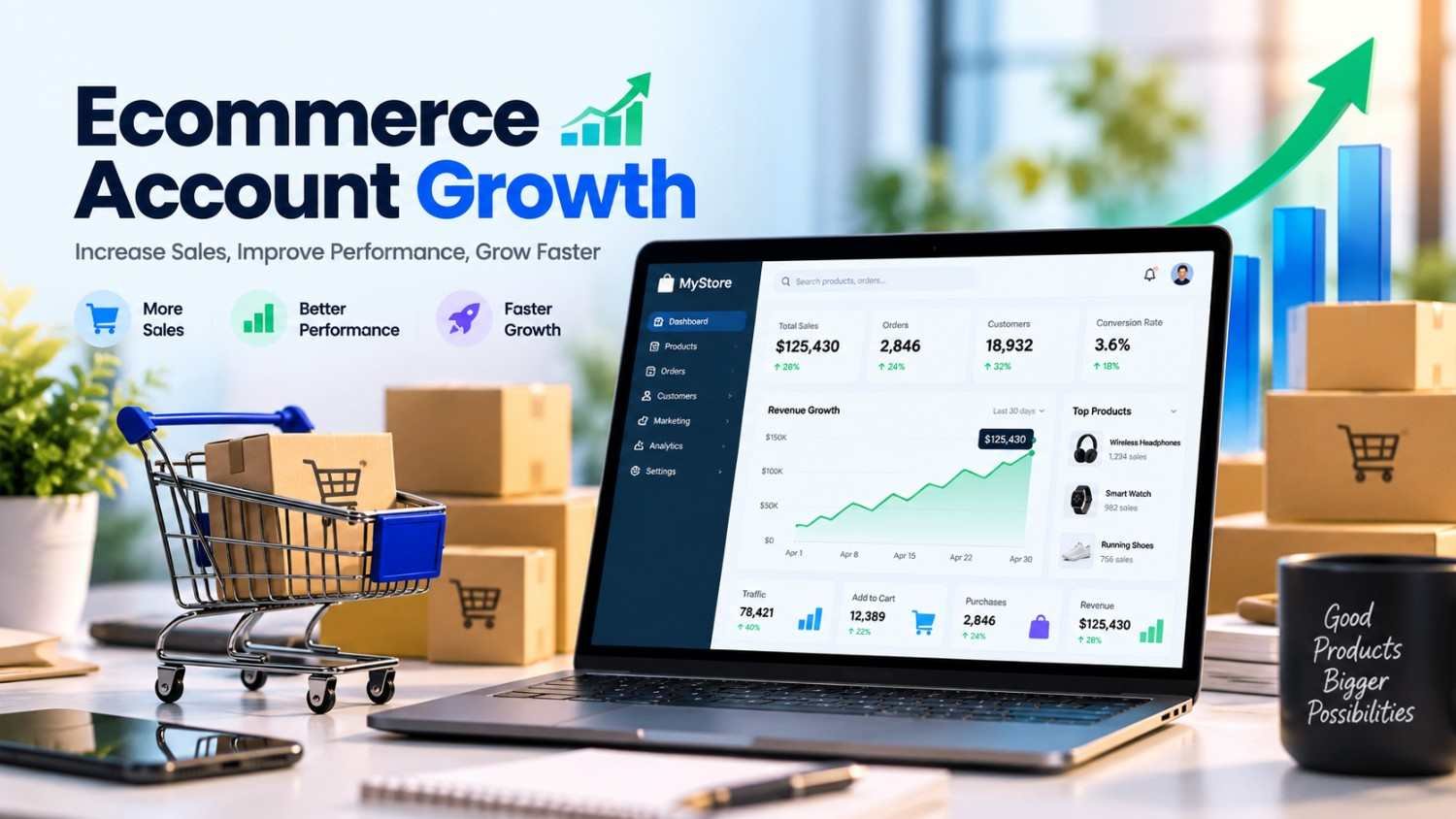
The ecommerce industry is growing rapidly, creating new opportunities for businesses, brands, and online sellers. Platforms like Amazon, Flipkart, Meesho, and other online marketplaces allow businesses to reach thousands of potential customers without opening a physical store.
However, creating a seller account and listing products is not enough to build a successful ecommerce business. With increasing competition, changing customer expectations, and marketplace algorithms, sellers need a proper growth strategy to achieve consistent sales and long-term profitability.
Ecommerce account growth is not just about increasing orders. It is about improving product visibility, optimizing listings, managing advertising campaigns, maintaining account health, and building a profitable online business.
In this comprehensive guide, we will discuss the most effective strategies to grow your ecommerce seller account, improve product rankings, increase conversions, and build a sustainable online business.
1. What Is Ecommerce Account Growth?
Ecommerce account growth refers to the process of improving the overall performance of an online seller account to generate more sales, attract new customers, and increase business profitability.
Whether you sell products on Amazon, Flipkart, Meesho, or your own ecommerce website, account growth requires continuous improvements in multiple business areas.
The major objectives of ecommerce account growth include:
- Increasing product visibility in marketplace search results.
- Improving organic product rankings.
- Generating more customer orders.
- Increasing product conversion rates.
- Reducing unnecessary advertising expenses.
- Maintaining positive customer reviews and ratings.
- Improving inventory and order management.
- Increasing revenue while protecting profit margins.
A successful ecommerce business focuses on all these factors rather than depending only on paid advertising or discounts.
2. Optimize Your Product Listings for Better Visibility
Product listing optimization is one of the most important factors in ecommerce account growth.
When customers search for products online, they usually compare multiple listings before making a purchase. A well-optimized product listing helps customers understand the product and increases the chances of conversion.
Write SEO-Friendly Product Titles
Your product title should clearly explain what you are selling. It should include relevant search keywords, product features, and important details.
For example:
Poor Product Title:
Hair Oil for Men and Women
Optimized Product Title:
Rosemary Hair Oil for Men and Women – Nourishing Hair & Scalp Oil, 100ml
The optimized title provides more useful information and helps customers identify the product.
However, sellers should always follow the title formatting and keyword policies of their respective marketplaces.
Use High-Quality Product Images
Product images play a major role in customer purchasing decisions.
Customers cannot physically touch or examine products while shopping online. Therefore, product images must communicate quality, appearance, size, and features.
A professional ecommerce listing should include:
- Clear product images with a clean background.
- Multiple product angles.
- Lifestyle images showing real-world product usage.
- Infographic images explaining product features.
- Product dimensions and size details.
- Comparison images, where relevant and accurate.
High-quality images can improve customer confidence and help increase conversion rates.
Write Clear Product Descriptions
Product descriptions should explain how the product works, its major features, and why customers may find it useful.
Avoid complicated language and unnecessary technical terms.
Focus on answering common customer questions and explaining genuine product benefits.
Growth Tip: Review your product listings regularly and update titles, images, descriptions, and keywords based on customer behavior and marketplace performance.
3. Conduct Proper Keyword Research
Keyword research helps ecommerce sellers understand what potential customers are searching for.
Using relevant keywords increases the chances of products appearing in marketplace search results.
For example, a seller offering a hair care product might research keywords such as:
- Rosemary Hair Oil
- Hair Nourishment Oil
- Hair and Scalp Oil
- Hair Oil for Men
- Hair Oil for Women
Not every keyword is suitable for every product. Sellers should select keywords that accurately describe their products.
How to Find Relevant Keywords
Start by analyzing marketplace search suggestions and competitor product listings.
You can also use keyword research tools and marketplace advertising reports to understand customer search behavior.
Focus on keywords that have:
- Strong relevance to your product.
- Reasonable search demand.
- Clear customer buying intent.
- Suitable competition levels.
Avoid adding irrelevant keywords simply to attract more traffic. Irrelevant traffic can reduce conversion efficiency and waste advertising budgets.
4. Improve Product Conversion Rates
Increasing product traffic is important, but converting visitors into paying customers is equally necessary.
Conversion rate measures the percentage of visitors or product sessions that result in an order.
Conversion Rate = (Orders ÷ Product Sessions) × 100
For example, if your product receives 1,000 sessions and generates 50 orders, the conversion rate is 5%.
A better conversion rate means more customers are purchasing after viewing your product.
Strategies to Improve Conversion Rates
Competitive Pricing: Analyze competitor prices and select a price that supports both customer demand and your profitability.
Professional Product Images: Use clear images that accurately represent the product.
Detailed Product Information: Mention specifications, dimensions, usage instructions, and relevant features.
Customer Reviews: Encourage genuine customer feedback through methods permitted by the marketplace.
Fast Delivery: Maintain sufficient inventory and use reliable fulfillment options.
Clear Return Information: Help customers understand applicable return and replacement policies.
Conversion improvements can generate additional sales from existing traffic without necessarily increasing advertising spending.
5. Use Ecommerce Advertising Strategically
Paid advertising is an important growth tool for sellers who want to improve product visibility and attract potential buyers.
Amazon Ads, Flipkart Ads, and other marketplace advertising platforms offer promotional options that can help sellers reach customers.
However, running advertisements without proper planning can lead to unnecessary expenses.
Start With a Defined Advertising Budget
Before launching advertising campaigns, calculate how much you can afford to spend on customer acquisition.
Consider:
- Product selling price.
- Product purchase or manufacturing cost.
- Marketplace commissions and fees.
- Shipping and packaging expenses.
- Expected return-related costs.
- Desired profit margin.
Your advertising budget should support your business goals without creating unsustainable losses.
Monitor Important Advertising Metrics
ACOS (Advertising Cost of Sales)
ACOS shows the percentage of attributed advertising sales spent on advertisements.
ACOS = (Advertising Spend ÷ Advertising Sales) × 100
ROAS (Return on Ad Spend)
ROAS measures how much attributed revenue your advertising generates compared with the amount spent.
ROAS = Advertising Sales ÷ Advertising Spend
CTR (Click-Through Rate)
CTR indicates the percentage of ad impressions that generate clicks.
CTR = (Clicks ÷ Impressions) × 100
CPC (Cost Per Click)
CPC represents the average cost paid for each advertising click.
CPC = Advertising Spend ÷ Clicks
These metrics help sellers evaluate advertising efficiency and identify opportunities for improvement.
A lower ACOS is not automatically better for every business. The ideal target depends on product margins, growth objectives, and whether the campaign is focused on acquiring new customers or generating immediate profits.
6. Maintain Strong Ecommerce Account Health
Account health is a critical factor in long-term ecommerce business growth.
Marketplaces expect sellers to provide a reliable shopping experience and follow their selling policies.
Poor account performance can lead to reduced selling privileges, account restrictions, or suspension.
Important Account Health Factors
Order Defect Rate: Monitor negative customer experiences and relevant marketplace performance indicators.
Order Cancellation: Avoid cancellations caused by incorrect inventory or operational problems.
Shipping Performance: Dispatch orders on time and maintain accurate tracking information.
Customer Complaints: Respond professionally and resolve genuine customer issues.
Marketplace Policy Compliance: Follow product listing, intellectual property, customer communication, and selling policies.
Account health requirements vary across marketplaces, so sellers should review their platform’s current performance standards.
Professional Tip: Check your seller dashboard regularly rather than waiting for a serious account warning.
7. Build a Strong Pricing Strategy
Pricing directly affects sales, conversion rates, and business profitability.
Many new sellers believe that offering the lowest price is the easiest way to increase orders.
However, continuously reducing prices without calculating costs can damage profitability.
A proper pricing strategy should consider the complete cost structure.
Calculate Your Product Profitability
For example, suppose a product has the following costs:
| Expense | Amount |
|---|---|
| Product Cost | ₹200 |
| Packaging Cost | ₹20 |
| Marketplace Fees | ₹80 |
| Shipping Cost | ₹50 |
| Advertising Cost | ₹40 |
| Total Cost | ₹390 |
| Selling Price | ₹499 |
| Estimated Profit | ₹109 |
In this simplified example, the estimated profit is ₹109 per order before any additional applicable taxes, refunds, or other business expenses not included above.
Understanding actual profitability helps sellers make informed pricing decisions.
Instead of competing only on price, focus on better product presentation, customer experience, and product quality.
8. Improve Inventory Management
Inventory management is essential for ecommerce account growth.
If your best-selling products frequently go out of stock, you may lose potential sales and customers.
On the other hand, maintaining too much inventory can increase storage expenses and block working capital.
Best Practices for Inventory Management
- Identify fast-selling and slow-selling products.
- Monitor available stock regularly.
- Maintain appropriate stock levels for popular products.
- Estimate demand using historical sales data.
- Plan inventory ahead of seasonal demand.
- Avoid purchasing excessive quantities without demand validation.
- Track returns and damaged inventory.
For example, if a product consistently sells 10 units per day and your supplier requires 15 days for replenishment, you should account for at least the expected demand during that lead time, plus an appropriate safety stock.
Proper inventory management helps sellers maintain sales continuity and use their working capital more effectively.
9. Improve Customer Reviews and Ratings
Customer trust plays an important role in ecommerce purchasing decisions.
Before placing an order, many customers check product ratings, reviews, and seller feedback.
A product with genuine positive reviews and accurate information can create greater confidence among potential buyers.
How to Improve Customer Satisfaction
Deliver Quality Products: Ensure the product matches the description and images.
Use Secure Packaging: Protect products from damage during transportation.
Provide Accurate Information: Avoid misleading claims or exaggerated features.
Respond to Customer Issues: Resolve complaints professionally and within the platform’s requirements.
Encourage Genuine Feedback: Use approved, neutral review-request methods where permitted.
Never purchase fake reviews, offer prohibited incentives, or attempt to manipulate product ratings.
Long-term customer trust is more valuable than artificial short-term improvements.
10. Analyze Competitors Regularly
Competitor analysis helps ecommerce sellers understand their market position.
By studying successful competing products, sellers can identify opportunities to improve their listings and business strategies.
What Should You Analyze?
Product Pricing: Compare your pricing with similar products.
Listing Quality: Review competitor images, titles, descriptions, and product information.
Customer Feedback: Study recurring complaints and customer expectations.
Product Features: Identify features that differentiate competing products.
Market Demand: Observe product categories and seasonal trends.
Promotional Strategies: Understand the types of discounts and offers competitors provide.
The objective of competitor analysis is not to copy competitors. It is to understand the market and create a better value proposition for customers.
11. Use Data Analytics for Better Decision-Making
Successful ecommerce sellers make decisions based on performance data rather than assumptions.
Every ecommerce seller should regularly monitor key business metrics.
Important Ecommerce KPIs
| KPI | Why It Matters |
|---|---|
| Total Sales | Measures overall sales performance |
| Number of Orders | Tracks customer purchases |
| Conversion Rate | Measures listing effectiveness |
| Advertising ACOS | Tracks advertising cost efficiency |
| ROAS | Evaluates advertising revenue performance |
| Average Order Value | Measures revenue per order |
| Return Rate | Highlights product or customer experience issues |
| Net Profit | Measures actual business profitability |
| Inventory Turnover | Helps evaluate stock movement |
Weekly Performance Analysis
Every week, review the performance of your seller account.
Compare sales results with previous periods and identify products that are performing well.
If sales are decreasing, investigate potential causes such as:
- Reduced product visibility.
- Increased competitor activity.
- Poor conversion rates.
- Inventory shortages.
- Rising advertising costs.
- Pricing changes.
- Negative customer feedback.
Making regular data-driven improvements is one of the most reliable approaches to long-term ecommerce growth.
12. Focus on Organic Sales Growth
Paid advertising can increase visibility, but relying completely on advertisements may increase customer acquisition costs.
Organic sales are generated when customers find and purchase your products without clicking a paid advertisement.
Improving organic sales helps build a more sustainable business.
How to Improve Organic Performance
Optimize product listings with relevant keywords and accurate information.
Maintain competitive pricing and sufficient inventory.
Improve conversion rates through better product presentation and customer experience.
Provide reliable order fulfillment and maintain strong account health.
Monitor product search performance and adjust your strategy when necessary.
Organic visibility depends on each marketplace’s ranking systems, which may consider multiple factors and can change over time.
Therefore, sellers should focus on overall product quality and customer experience rather than searching for shortcuts.
13. Expand Your Product Portfolio Strategically
Adding new products can create growth opportunities, but launching products without proper research may increase financial risk.
Before expanding your catalog, evaluate market demand, customer expectations, competition, and profit potential.
Product Expansion Strategy
Start by identifying your best-performing product categories.
Research related products that may appeal to similar customers.
Evaluate manufacturing or supplier costs, expected selling prices, marketplace fees, and advertising requirements.
Launch new products in manageable quantities to test market demand.
For example, a brand selling hair oil may consider expanding into related hair care products such as shampoo, conditioner, or hair serum after completing proper research.
A focused product expansion strategy can help increase revenue while building a stronger brand identity.
14. Build a Recognizable Ecommerce Brand
Long-term ecommerce success depends on more than individual product sales.
Building a recognizable brand can improve customer trust and help differentiate your business from competitors.
Essential Elements of Ecommerce Branding
Brand Identity: Create a consistent logo, color combination, and visual style.
Product Packaging: Use professional packaging that accurately represents your product.
Consistent Quality: Maintain reliable product standards across orders.
Brand Communication: Use a clear and consistent tone across product listings and marketing materials.
Customer Experience: Make every stage of the purchasing journey as smooth as possible.
Businesses that consistently deliver value have a stronger foundation for repeat purchases and long-term growth.
15. Create a 90-Day Ecommerce Account Growth Plan
A structured action plan helps sellers implement growth strategies in an organized way.
First 30 Days: Account Audit and Optimization
During the first month, focus on understanding your current account performance.
- Review account health and seller metrics.
- Analyze existing product listings.
- Improve titles, images, descriptions, and keywords.
- Identify profitable and unprofitable products.
- Evaluate competitor pricing.
- Check inventory availability.
- Review advertising performance.
Goal: Build a strong foundation for future account growth.
Days 31–60: Sales and Conversion Improvement
During the second month, focus on improving sales efficiency.
- Optimize advertising campaigns.
- Reduce irrelevant advertising traffic.
- Test product images and pricing where appropriate.
- Improve underperforming listings.
- Review customer feedback.
- Monitor conversion rates.
- Improve inventory planning.
Goal: Increase sales opportunities while controlling unnecessary expenses.
Days 61–90: Scaling and Business Expansion
During the third month, focus on expanding successful strategies.
- Increase advertising budgets for profitable opportunities.
- Explore relevant new product opportunities.
- Improve organic visibility.
- Strengthen product branding.
- Develop inventory forecasts.
- Analyze profitability at the product level.
- Prepare a longer-term ecommerce growth strategy.
Goal: Develop a scalable business model based on proven performance.
This 90-day plan is a practical framework, not a guarantee of specific sales results. Actual growth depends on your product category, competition, execution, and available resources.
16. Common Mistakes That Slow Down Ecommerce Account Growth
Many ecommerce sellers struggle because they repeat avoidable business mistakes.
Mistake 1: Focusing Only on Sales
High revenue does not always mean high profits. Sellers should monitor their complete expense structure.
Mistake 2: Poor Product Listing Quality
Incomplete descriptions, unclear images, and irrelevant keywords can reduce conversions.
Mistake 3: Running Ads Without Analysis
Advertising expenses can increase quickly when campaigns are not regularly optimized.
Mistake 4: Ignoring Customer Feedback
Repeated complaints may reveal product quality, packaging, or listing problems.
Mistake 5: Incorrect Inventory Planning
Stockouts and excessive inventory can both create financial and operational challenges.
Mistake 6: Competing Only on Low Prices
Excessive discounting can reduce margins and make long-term growth difficult.
Mistake 7: Not Tracking Product-Level Profit
Without profitability analysis, sellers may unknowingly continue selling loss-making products.
Avoiding these mistakes can significantly improve the quality of business decisions.
17. Why Professional Ecommerce Account Management Matters
Managing a growing ecommerce business requires consistent attention to multiple activities.
Product listing optimization, advertising management, inventory planning, pricing analysis, customer service, and account health monitoring all require time and expertise.
Professional ecommerce account management brings these activities together into a structured process.
A professional account management approach typically includes:
- Account performance audits.
- SEO-focused product listing optimization.
- Advertising campaign planning and monitoring.
- Sales and conversion analysis.
- Marketplace account health monitoring.
- Inventory coordination.
- Competitor research.
- Product performance reporting.
- Growth strategy development.
For businesses managing large product catalogs or multiple marketplaces, a structured management process can improve operational efficiency.
However, professional management alone does not guarantee sales. Results still depend on product quality, demand, pricing, competition, and execution.
18. Frequently Asked Questions About Ecommerce Account Growth
Q1. How can I increase sales on my ecommerce seller account?
You can improve sales opportunities by optimizing product listings, using relevant keywords, running controlled advertising campaigns, maintaining competitive prices, and improving customer experience.
Q2. How long does ecommerce account growth take?
There is no fixed timeline. Some improvements may show results relatively quickly, while building consistent organic visibility and profitability can take several months or longer.
Q3. Is paid advertising necessary for ecommerce growth?
Paid advertising is not mandatory, but it can help increase product visibility, particularly for new listings. Sellers should evaluate advertising based on profitability and business goals.
Q4. What is the most important factor in ecommerce growth?
No single factor determines success. Product demand, listing quality, pricing, conversion rate, inventory availability, customer satisfaction, and profitability all contribute to growth.
Q5. How can I grow my Amazon or Flipkart seller account?
Focus on marketplace-compliant listing optimization, product research, advertising analysis, accurate inventory management, competitive pricing, and strong customer service.
Q6. What is the difference between ecommerce sales growth and account growth?
Sales growth generally refers to increasing revenue or orders. Account growth is broader and includes improvements in visibility, conversions, profitability, operational performance, and customer satisfaction.
Conclusion
Ecommerce account growth requires a combination of smart planning, regular optimization, and continuous performance analysis.
Whether you are a new seller or an established online business, your focus should be on creating a strong foundation for sustainable growth.
Start by improving your product listings, researching relevant keywords, optimizing advertising expenses, and maintaining excellent account health.
At the same time, monitor your inventory, analyze competitors, understand customer expectations, and track actual profitability.
The key to successful ecommerce account growth is not simply selling more products. It is building a profitable, reliable, and scalable online business.
With the right strategies, consistent execution, and data-driven decisions, ecommerce sellers can improve their marketplace performance and create long-term business opportunities.

1 Comment
Pingback: Meesho Return Kam Kaise Kare ? 15 Best Proven Tips for Sellers in 2026 - Daily Usa Story